
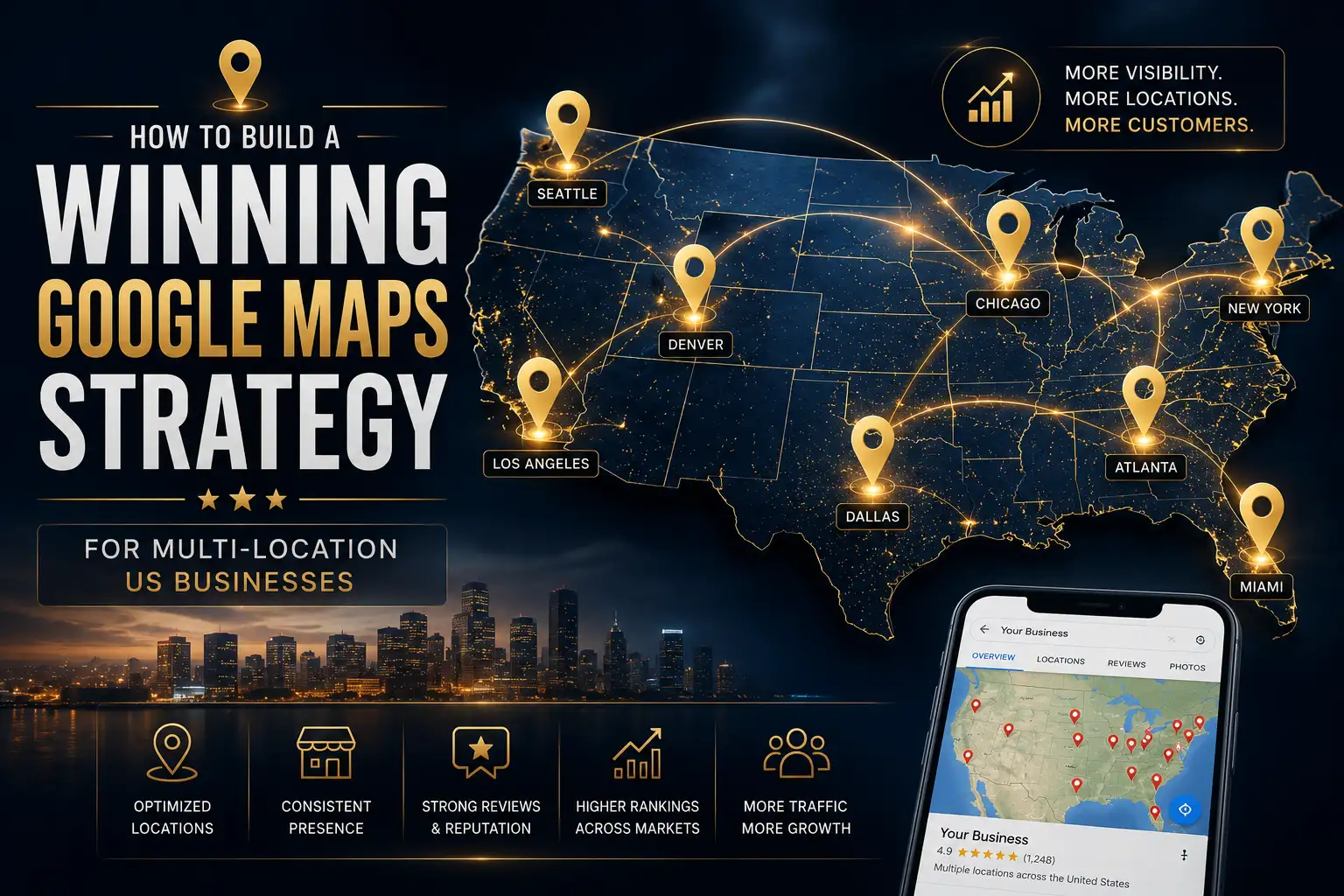
Multi-location businesses face unique Google Maps challenges and unique opportunities. Learn the specific strategies that help businesses with multiple US locations dominate local search in every market they serve.
Operating in multiple locations creates a distinct set of local SEO challenges and opportunities. While you benefit from accumulated brand authority and potentially consistent service quality across markets, you also face the complexity of managing multiple GBP profiles, maintaining NAP consistency across dozens of platforms, preventing cannibalization between nearby locations, and creating location-specific content that genuinely resonates in each distinct market.
The foundation of multi-location Google Maps success is a separate, fully optimized GBP profile for each physical location. Each profile must have a unique, location-specific business name format (following Google’s guidelines for chain business naming), its own phone number, its own website URL (ideally linking to a location-specific landing page rather than the homepage), and its own set of location-specific photos and posts.
Location-specific content is the most critical differentiator between multi-location businesses that rank well in each market and those that struggle everywhere. Generic content that could apply to any of your locations fails to establish geographic relevance for any of them. Invest in creating genuinely location-specific content for each market: local team profiles, neighborhood-specific case studies, references to local community involvement, and reviews that mention specific locations.
Managing reviews across multiple locations requires systematic processes. Implement a location-tagged review request system so that reviews clearly reference the specific location customers visited, and ensure review responses are managed by someone who knows each individual location’s context.
For chains with multiple locations in the same metro area, establishing distinct service area definitions for each GBP profile prevents cannibalization in search results. Work with Google’s service area settings to clearly delineate which neighborhoods each location serves.
Citation management at scale requires either dedicated software (BrightLocal, Yext, or Semrush’s listing management tools) or careful manual tracking. Inconsistencies in multi-location NAP data are significantly more common than in single-location businesses and have outsized negative impacts on local visibility.
Frequently Asked Questions
Q: Should all locations of my business have the same website or separate location-specific sites?
A: In most cases, a single domain with location-specific subpages or subfolders is the most SEO-efficient approach. It consolidates domain authority while allowing unique, location-optimized content for each market. Separate domains dilute your overall authority and create management complexity.
Q: How do I prevent my locations from competing against each other in search results?
A: Define non-overlapping service areas for each GBP profile, create distinct location pages on your website with unique content, and use geo-targeted paid ads to reinforce each location’s geographic territory. Clear service area differentiation prevents internal competition in most categories.
Q: What’s the most efficient way to manage local SEO across 5 or more locations?
A: Invest in a listing management platform that synchronizes NAP data across directories for all locations simultaneously. Develop location-specific content templates that maintain strategic structure while allowing location-unique customization. Implement centralized review monitoring with location-specific response protocols.